
The CAC Crisis & the AI Solution: A Blueprint for Profitable Customer Acquisition
Your Ultimate Blueprint for Profitable Customer Acquisition


Part I: The Modern Acquisition Challenge: Navigating the Economics of Growth
In the contemporary digital marketplace, the pursuit of growth has become a complex balancing act.
While acquiring new customers is the lifeblood of any expanding enterprise, the costs associated with this acquisition have escalated, creating a precarious environment for businesses of all sizes.
You need an AI-powered customer acquisition engine.
Navigating this landscape requires a sophisticated understanding of the fundamental economics of growth, moving beyond vanity metrics to focus on the core drivers of sustainable profitability.
This section deconstructs the essential metrics that govern business viability, establishes data-driven benchmarks for 2026, and examines the unique pressures faced by small businesses and solopreneurs in their quest for scale.
Here’s your Modern AI Toolkit With a Practical Guide for Solopreneurs and SMBs…
What Is an AI-Powered Customer Acquisition Engine?
An AI-powered customer acquisition engine is a system that uses artificial intelligence to automate, optimize, and personalize how a business attracts, converts, and retains customers—reducing customer acquisition cost (CAC) while increasing customer lifetime value (CLV).
The Twin Pillars of Sustainable Growth: CLV and CAC
At the heart of a sustainable business model lie two interdependent metrics:
Customer Lifetime Value (CLV or LTV) and Customer Acquisition Cost (CAC).
While seemingly straightforward, a deep understanding of their calculation and interplay is the first step toward building a resilient growth engine.
Customer Lifetime Value quantifies the total projected revenue a business can expect from a single customer throughout their entire relationship with the company.
It provides a long-term perspective on the value of each customer acquired.
The standard formula is:
CLV=(Average Purchase Value×Purchase Frequency)×Average Customer Lifespan
This calculation underscores that value is not derived from a single transaction but from a continued relationship built on repeat purchases and loyalty.
On the other hand, Customer Acquisition Cost measures the total expense incurred to convert a potential lead into a new customer.
A comprehensive CAC calculation must include all associated sales and marketing costs over a specific period, such as a month, quarter, or year. The formula is:
CAC=New Customers AcquiredTotal Marketing and Sales Costs
These costs are extensive and go far beyond simple ad spend.
A true accounting of CAC includes marketing and sales team salaries, commissions and bonuses, the cost of software like CRMs and marketing automation tools, content production, online advertising, and expenses for events and trade shows.
According to a 2024 CMO survey, businesses spend approximately 10.1% of their total revenue on marketing alone, highlighting the significant investment required.
However, analyzing these metrics in isolation presents an incomplete picture. The most critical indicator of a business's health and the efficiency of its growth strategy is the relationship between what a customer is worth and what it costs to acquire them—the CLV to CAC ratio.
A healthy ratio ensures that the revenue generated from a customer significantly exceeds the initial investment, paving the way for profitable customer relationships. Across numerous industries and business models, a CLV:CAC ratio of
3:1 is widely regarded as the "golden ratio" or ideal benchmark for a sustainable business.
This means for every dollar spent on acquiring a customer, the business generates three dollars in lifetime value.
The interpretation of this ratio, however, requires nuance. It is not a static figure but a dynamic indicator that reflects a company's strategic posture.
A ratio below 3:1 often signals an unsustainable model where acquisition costs are too high or customer value is too low, creating a financial "debt" that may take too long to repay.
Conversely, a ratio significantly higher than 5:1, while appearing positive, may indicate underinvestment in marketing. It suggests a company could be spending more aggressively to accelerate growth and capture greater market share without sacrificing profitability.
This reveals a more sophisticated understanding of the metric. The "ideal" 3:1 ratio is not an absolute truth but a strategic compass.
A deviation from this benchmark is not inherently a failure but often a reflection of a deliberate business decision. For instance, companies in highly competitive markets or well-funded startups in a land-grab phase may intentionally operate at a lower ratio to prioritize rapid market penetration over immediate profitability.
Their goal is long-term dominance, and a temporarily unfavorable ratio is a calculated investment toward that end.
In this context, the CLV:CAC ratio transcends its role as a simple Key Performance Indicator (KPI) and becomes a tool for strategic dialogue at the executive level.
It prompts critical questions: Does our current ratio align with our strategic growth objectives?
Is a low ratio a sign of inefficiency or a conscious investment in future market leadership?
Is a high ratio a sign of efficiency or of a timid strategy that risks ceding ground to more aggressive competitors?
The 2025 Benchmark Report: CAC & CLV: CAC Ratios Across Industries
The financial pressures of customer acquisition are not uniform; they vary significantly across industries, influenced by factors like sales cycle complexity, customer retention rates, and underlying business models.
Understanding these industry-specific benchmarks is crucial for businesses to accurately assess their own performance.
The Software-as-a-Service (SaaS) industry, characterized by recurring revenue and often complex sales cycles, typically sees a healthy CLV:CAC ratio between 3:1 and 5:1.
The average CAC for a SaaS company falls in the range of $200 to $600, with B2B SaaS averaging around $239 and enterprise software frequently exceeding $400 due to longer sales processes and higher contract values.
In contrast, the eCommerce sector operates on different dynamics.
With lower average transaction values and more variable customer retention, the target CLV:CAC ratio is often between 2:1 and 4:1.
The average CAC is significantly lower, typically between $68 and $84. However, this figure masks wide variation within the sector.
For example, the average CAC for Fashion & Apparel is $66, while for Jewelry it is $91, and for high-ticket items like Consumer Electronics, it can soar to $377.
Other industries show their own unique profiles. Fintech companies often operate with a tighter CLV:CAC ratio of 2:1 to 3:1, while industries with extremely high customer value and long retention, like Commercial Insurance, can sustain a much higher ratio of 5:1.
Across the broader B2B landscape, the average CAC is a substantial $536.
These benchmarks are further influenced by geography and company size.
For instance, eCommerce CACs are reported to be 15-25% higher on the US West Coast and 40-60% lower in Southeast Asia.
Moreover, a company's CAC often fluctuates as it grows, sometimes increasing as it scales before achieving economies of scale at higher revenue brackets.
The following framework consolidates these data points, providing you a clear, actionable benchmark for businesses to compare performance against industry standards.
Here’s your Modern AI Toolkit With a Practical Guide for Solopreneurs and SMBs…
The Solopreneur and SMB Dilemma: Scaling Growth on a Limited Budget
While large corporations can absorb the costs of customer acquisition, solopreneurs and small-to-medium-sized businesses (SMBs) face a much starker reality.
For them, the efficiency of customer acquisition is a matter of survival.
This is where the CAC Payback Period becomes an even more critical metric. It measures the number of months it takes for a business to earn back the money it spent to acquire a customer.
For cash-flow-sensitive businesses, a shorter payback period is essential. Industry benchmarks show a clear correlation between company size and acceptable payback periods: very small businesses with fewer than 20 employees should aim for a payback period of 9-12 months, while midmarket companies can sustain longer periods of 14-18 months.
The challenge for the solopreneur is particularly acute. They often begin with minimal capital, driven by the desire to escape a traditional 9-to-5 job and build something of their own.
Their journey is defined by a "hustle" to find their first paying customers, often through painstaking manual outreach.
They wear multiple hats, acting as the CEO, marketer, salesperson, and support agent, all while battling the repetitive tasks that drain their most valuable resource: time.
In this environment, the concept of waiting 12 months to recoup the cost of a single customer is a direct threat to the business's existence.
This re-contextualizes the entire problem for this crucial segment of the economy. For a solopreneur or a bootstrapped SMB, CAC is fundamentally a cash flow and survival metric.
The strategies they employ to reduce it cannot be long-term, capital-intensive projects. They must be low-cost, fast to implement, and focused on delivering an immediate impact on revenue and profitability.
This imperative sets the stage for the transformative potential of AI-powered businesses, which offer a pathway to achieve enterprise-level efficiency on a solopreneur's budget.
Part II: The AI Revolution in Marketing: From Automation to Intelligence
The escalating pressures of customer acquisition are converging with a technological inflection point: the widespread integration of Artificial Intelligence into the business world.
AI is no longer a futuristic concept but a tangible, transformative force that is fundamentally reshaping how companies attract, engage, and retain customers. This section quantifies the scale of this revolution and provides a strategic framework for understanding how AI directly addresses the challenges of CAC reduction.
The Unstoppable Rise of AI in the Marketing Stack
The adoption of AI in marketing is not a gradual trend; it is an explosive, market-defining shift. The global AI marketing industry, valued at $47.32 billion in 2025, is projected to more than double to $107.5 billion by 2028, expanding at a compound annual growth rate (CAGR) of 36.6%.
The generative AI market, a key component of this growth, was valued at $62.75 billion in 2025 alone.
These macroeconomic figures are reflected in widespread adoption at the organizational level. An overwhelming 91.5% of the world's leading businesses have already made investments in AI technologies.
More tellingly, AI has become a standard tool in the marketer's daily workflow, with
88% of digital marketers reporting they use AI in their day-to-day tasks. The forward-looking sentiment is equally strong, with
92% of businesses planning to invest in generative AI over the next three years.
This technological integration is profoundly altering the nature of marketing work. The pervasive fear of AI replacing jobs is giving way to a more nuanced reality of role evolution.
AI excels at automating repetitive, data-intensive tasks, thereby freeing up human capital for higher-value strategic and creative work. Evidence suggests that companies leveraging AI across their marketing operations will pivot
75% of their staff's activities from production to strategy. Marketers themselves confirm this shift, with
83% reporting that AI frees up their time to focus on more strategic initiatives. This evolution comes with a significant financial incentive: roles that require AI fluency command an average salary premium of
28%, a boost that extends even to non-technical fields like content creation and human resources.
This rapid, widespread adoption has created a critical disconnect within many organizations. While 88% of marketers use AI tools, a staggering 70% report that their employers provide no formal training on how to use them effectively.
Furthermore, 43% of marketers who have adopted AI admit they do not know how to maximize its value. This chasm between tool adoption and skill acquisition creates a significant "skill gap."
This gap represents a unique and powerful competitive advantage for agile individuals—solopreneurs, freelancers—and SMBs. A small, nimble team can learn, experiment with, and master these new AI tools far more quickly than a large, bureaucratic corporation can design and implement a company-wide retraining program.
This agility allows smaller players to achieve levels of efficiency, personalization, and analytical depth that were previously the exclusive domain of enterprises with massive budgets.
The immediate opportunity, therefore, lies not just in using AI, but in mastering it faster than the competition, turning knowledge into a competitive moat that can level the playing field.
Beyond Cost-Cutting: The Core Levers of AI for CAC Reduction
To effectively leverage AI for customer acquisition, it is essential to move beyond a simple list of features and understand the core strategic levers through which AI reduces CAC. These benefits can be framed around three primary operational capabilities that were previously impossible to achieve at scale.
Hyper-Personalization at Scale: For decades, personalization has been the holy grail of marketing. AI finally makes it a scalable reality. By analyzing vast datasets of user behavior, preferences, and historical interactions, AI can generate tailored content, personalized product recommendations, and dynamically adjusted ad creative for millions of individual users simultaneously. This level of relevance dramatically increases engagement and conversion rates, ensuring that marketing spend is directed toward messaging that resonates, thereby lowering the cost per acquisition.
Predictive Lead Intelligence: A significant portion of traditional marketing and sales budgets is wasted on pursuing low-intent or poor-fit leads. AI addresses this inefficiency by applying predictive analytics to lead generation and scoring. AI models can analyze thousands of behavioral signals—from website clicks and content downloads to social media engagement—to identify patterns that indicate strong purchase intent. This enables marketing and sales teams to focus their resources exclusively on the prospects most likely to convert, dramatically improving the efficiency of the sales pipeline and reducing wasted effort.
24/7 Automated Engagement: In a 24/7 digital economy, speed is paramount. Research shows that a significant number of sales opportunities—as high as 98%—can be lost due to slow or poorly managed responses. AI-powered agents and chatbots solve this problem by providing instantaneous, around-the-clock engagement. They can greet website visitors, answer common questions, qualify leads based on predefined criteria, and even book appointments, ensuring that no potential customer is lost due to a delayed response. This is particularly transformative for solopreneurs and small teams who cannot be available at all hours, effectively creating a tireless digital sales assistant that works to lower CAC even when they are not.
Part III: An AI-Powered Funnel: Tactical Implementation for CAC Optimization
Understanding the strategic levers of AI is the first step; applying them tactically across the customer acquisition funnel is where value is realized. By integrating AI at each stage—from initial awareness to final conversion and retention—businesses can systematically drive down CAC while simultaneously enhancing the customer experience.
This section provides a practical walkthrough of an AI-powered funnel.
Top of Funnel (Awareness & Discovery): Intelligent Content and Outreach
The top of the funnel is focused on attracting a broad audience and generating initial interest. AI transforms this stage from a costly, high-volume guessing game into a targeted, efficient operation.
AI for Content Creation & SEO: Content marketing is a cornerstone of organic growth, but it is traditionally time-consuming and resource-intensive. AI content creation tools like Jasper.ai and Copy.ai have revolutionized this process.
They can generate SEO-optimized drafts for blog posts, social media updates, ad copy, and landing pages in a fraction of the time it would take a human writer. The most effective strategy is not to replace human creativity but to augment it. Marketers should use AI for rapid first-draft generation and large-scale content repurposing, while a human provides the final strategic oversight, unique brand voice, and factual accuracy.
For example, a single, well-researched long-form article can be fed into an AI tool to generate a week's worth of derivative content, including social media posts, email newsletter summaries, and even video scripts, maximizing the ROI of each core content piece.
Furthermore, AI can assist in identifying and targeting long-tail keywords, such as "AI tools for trend-driven customer acquisition," which are less competitive and signal higher purchase intent—a critical strategy for new businesses seeking to gain a foothold in organic search.
AI for Paid Media Management: Paid advertising is often the fastest way to acquire customers but can also be the quickest way to burn through a budget. AI-powered ad management platforms bring a new level of intelligence and efficiency to paid media.
Google's Performance Max is a prime example. It is an AI-driven campaign type that automates targeting, bidding, and creative delivery across Google's entire ecosystem (Search, Display, YouTube, Gmail, etc.) from a single campaign setup.
Its AI models work to find the highest-ROI conversion paths and uncover new customer segments that a human analyst might miss, making it an ideal solution for lean teams without dedicated PPC experts.
Beyond Google, specialized AI platforms like Madgicx and Smartly.io offer even more granular control. These tools bridge the gap between creative production and media buying, using AI to automate A/B testing of ad copy and visuals, dynamically reallocate budgets to the best-performing ads in real-time, and generate dozens of creative variations at scale.
This continuous optimization ensures that every ad dollar is spent as effectively as possible. Testimonials from users of platforms like Madgicx report dramatic results, with one agency owner noting an
80% reduction in creative production costs thanks to its AI Ad Generator.
Middle of Funnel (Consideration & Engagement): Nurturing Leads with Precision
Once a potential customer is aware of a brand, the middle of the funnel is about nurturing their interest and guiding them toward a decision. AI automates and personalizes this critical stage at a scale previously unimaginable.
AI Chatbots & Conversational AI: AI-powered chatbots are a frontline tool for middle-funnel optimization and CAC reduction.
They serve as a 24/7 digital concierge on a company's website, instantly engaging visitors, answering frequently asked questions, and capturing lead information. More advanced chatbots can qualify leads by asking targeted questions about their needs, budget, and timeline, effectively automating the initial stages of the sales process.
This frees human sales representatives to focus their time exclusively on high-intent, pre-qualified leads. By providing immediate responses, chatbots also prevent the lead drop-off that occurs due to slow response times, a crucial factor when up to 98% of opportunities can be lost to delays.
AI-Driven CRM & Marketing Automation: Modern Customer Relationship Management (CRM) platforms, such as HubSpot, are increasingly embedding AI at their core to create intelligent nurturing systems.
A key feature is predictive lead scoring, where AI analyzes a prospect's digital body language—website pages visited, emails opened, content downloaded—to assign a score indicating their likelihood to purchase. This allows sales teams to systematically prioritize their efforts on the hottest leads.
Beyond scoring, AI enables automated, hyper-personalized nurturing sequences. For example, when a user downloads a whitepaper on a specific topic, an AI agent can automatically trigger a tailored email workflow.
This sequence might start with a thank you, followed by related case studies, an invitation to a relevant webinar, and finally, an offer for a demo.
The AI can adjust the content and timing of each message based on the user's engagement, ensuring that every lead receives the most relevant information at the most opportune moment, all without any manual intervention.
Bottom of Funnel (Conversion & Retention): Closing Deals and Maximizing CLV
The bottom of the funnel is where a prospect becomes a customer. AI provides powerful tools to increase conversion rates and, just as importantly, to maximize the long-term value of that customer, directly improving the CLV:CAC ratio.
AI for Conversion Rate Optimization (CRO): Even small improvements in conversion rate can lead to significant reductions in CAC. AI tools can help optimize this final step in several ways.
Funnel analysis platforms like Funnelytics use visual journey mapping to pinpoint exactly where users are abandoning the conversion process, allowing for targeted interventions. A major point of friction is cart abandonment. AI can trigger automated and highly personalized abandoned cart emails and push notifications, often with a tailored incentive, which is a very low-cost method for recovering otherwise lost sales and directly lowering overall CAC.
For active shoppers, AI can analyze their behavior in real-time to present strategic product bundles or personalized offers, which can increase both the average order value (AOV) and the likelihood of conversion.
AI in Customer Success & Retention (The CLV Multiplier): Reducing CAC is only one side of the profitability equation. A truly intelligent acquisition engine also focuses on increasing Customer Lifetime Value.
By improving retention, a business reduces its reliance on constantly acquiring new, expensive customers. AI plays a critical role here. An AI-powered self-service support ecosystem, including a robust knowledge base and intelligent chatbots, can resolve a high percentage of common customer inquiries without human intervention.
This not only reduces customer service costs but also provides instant answers, improving customer satisfaction.
Furthermore, AI can analyze customer data, usage patterns, and feedback (such as Net Promoter Score responses) to identify the happiest, most engaged customers. These individuals are prime candidates to become brand advocates.
The AI can then trigger automated requests for testimonials, reviews, or participation in a referral program, effectively turning a company's most satisfied customers into a powerful, low-cost acquisition channel.
Part IV: The Modern AI Toolkit: A Practical Guide for Solopreneurs and SMBs
The proliferation of AI has created a vast and often confusing landscape of tools, platforms, and pricing models. For the solopreneur or SMB leader, who is typically constrained by both budget and time, selecting the right tools is a critical decision.
This section demystifies the market, provides a framework for choosing a tool stack, and offers curated recommendations for the lean business.
Demystifying the AI Tool Landscape and Pricing Models
Understanding the common pricing structures is the first step toward making an informed investment. Most AI marketing tools fall into one of three categories:
Subscription Tiers: This is the most common model, used by platforms like Copy.ai and Jasper.ai. Businesses pay a fixed monthly or annual fee for access to a specific set of features and usage limits. This model offers predictable costs, which is beneficial for budgeting, but runs the risk of paying for features that go unused.
Usage-Based Credits: Platforms like Lindy.ai operate on a pay-as-you-go model. Users purchase "credits" that are consumed as they perform tasks. This is highly flexible and allows for a very low-cost entry point, making it ideal for experimentation. However, costs can become unpredictable and spiral as usage scales, making it challenging to budget for.
Ad-Spend-Based Tiers: Tools focused on paid media optimization, such as Madgicx, often tie their pricing to the amount of ad spend being managed. This model aligns the tool's cost with the value it provides—as a business spends more, the tool's potential impact grows. However, it can become expensive for companies with large advertising budgets.
The selection of a tool and its pricing model is not merely a budgetary choice; it is a strategic decision that reflects a business's operational maturity.
There is a clear and logical progression in how businesses should approach building their AI tool stack.
For an Early-Stage Solopreneur, the primary constraints are cash and time, and the main goal is to validate an idea and acquire the first few customers. The ideal strategy is to leverage a stack of free and low-commitment tools.
This includes free platforms like the HubSpot Free CRM for basic lead tracking, the free tiers of content generators like Copy.ai for initial marketing materials, and usage-based tools like Lindy.ai's free plan to automate a few specific, painful tasks like email follow-ups. The focus is on maximum experimentation with minimal financial risk.
As the business enters the Growth Stage, it has likely achieved product-market fit and is now focused on scaling its acquisition channels efficiently. The pain point shifts from "finding any customer" to "finding customers profitably."
At this stage, investing in dedicated, subscription-based platforms for specific functions becomes justifiable. The business can now afford a fixed monthly cost for a tool like Madgicx to optimize a growing ad budget or SurferSEO to scale a proven content strategy, because the return on investment is more predictable.
Finally, at the Scale Stage, a mature SMB or enterprise faces the challenge of managing complexity across multiple teams, channels, and data sources. The strategic need shifts to a unified, integrated platform like the paid tiers of HubSpot or Salesforce.
These platforms serve as a single source of truth, integrating marketing, sales, and service data to enable complex, cross-functional automation and provide a holistic view of the entire customer journey.
This framework provides a strategic roadmap, allowing a business to not only select the right tools for its current needs but also to anticipate and plan for its future technological requirements.
Curated Tool Recommendations for the Lean Business
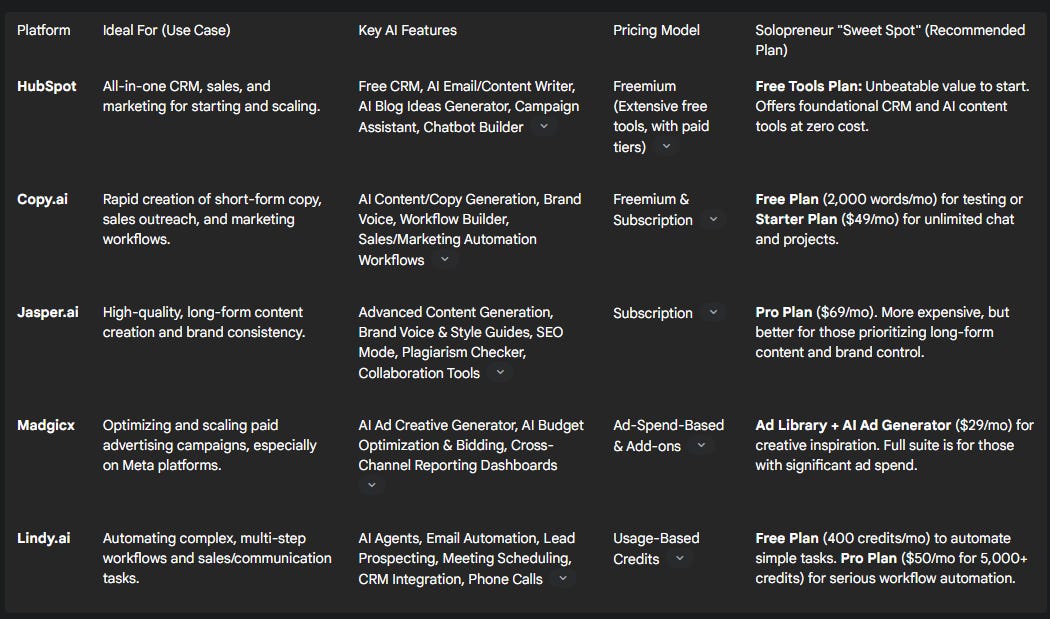
Navigating the crowded marketplace of AI tools can be overwhelming. The following table provides a comparative analysis of leading platforms, designed to help SMBs and solopreneurs make a quick, informed decision based on their specific needs and budget.
Table 1: Comparative Analysis of AI Marketing Platforms for SMBs
Tool Deep Dives:
The All-in-One Starter Pack (HubSpot): For any solopreneur or new business, HubSpot's suite of free AI tools is the undisputed best place to start. It provides a robust, AI-powered CRM to manage customer data, an AI Email Writer, a Blog Ideas Generator, and a Campaign Assistant to create copy for landing pages and ads—all at zero cost. This powerful combination of foundational tools provides immense value and a clear upgrade path as the business grows.
Content Creation Powerhouses (Copy.ai vs. Jasper.ai): For those focused on content, the choice between these two leaders depends on priorities. Copy.ai is generally more affordable and user-friendly, making it a strong choice for solopreneurs. It excels at generating short-form copy and is increasingly focused on automating sales and go-to-market workflows.
Jasper.ai, while more expensive, offers a more robust feature set for creating high-quality, long-form content. Its superior brand voice controls, SEO integrations, and collaboration features make it better suited for businesses where content is a primary driver of growth and brand consistency is paramount.
Paid Ad Optimization (Madgicx): Madgicx is a specialized tool for businesses ready to scale their paid advertising. Its core value proposition is using AI to directly lower CAC on platforms like Meta. Features like the AI Ad Generator, automated budget allocation, and real-time performance dashboards are designed to maximize ROI. However, its spend-based pricing model means it is best suited for businesses with a dedicated ad budget, and some user reviews indicate potential issues with customer support, which is a consideration for small teams.
Hyper-Automation Agent (Lindy.ai): Lindy.ai is for the more technically inclined solopreneur who wants to automate not just single tasks, but entire multi-step workflows. It can be configured to perform complex sequences like "find a new lead on LinkedIn matching my criteria, scrape their company website for key information, draft a personalized outreach email based on that information, add the lead to my CRM, and schedule a follow-up reminder." Its credit-based pricing makes it highly accessible to start experimenting with powerful automation.
Case Study - The Solopreneur's Playbook for AI-Driven Acquisition
The journey from a solo founder with an idea to a thriving business with a steady stream of customers is challenging.
Synthesizing the experiences of successful solopreneurs reveals a clear, repeatable playbook for leveraging AI to achieve this growth.
Step 1: Solve a Specific, Painful Problem. The most common mistake is building a broad, "revolutionary AI platform" that nobody understands or wants. Successful founders start by solving a single, acute pain point they understand deeply, often one they have experienced themselves. The focus is on utility, not technology for its own sake.
Step 2: Manual, Value-First Outreach. Before a single line of automation is written, the first customers must be found manually. This is the validation phase. Successful founders do not send generic cold emails. Instead, they embed themselves in online communities like Reddit, LinkedIn groups, or niche forums. They actively search for people who are already looking for a solution—those posting questions like "does anyone know a tool that can..." or expressing frustration with an existing competitor. The initial contact is always about providing genuine help and value, not a sales pitch. Only after establishing credibility is the founder's own tool mentioned as a potential solution.
Step 3: Implement Free & Low-Cost AI Tools. Once the initial manual outreach has validated the problem and solution, AI is introduced to automate the most repetitive tasks. This is where the solopreneur starts to reclaim their time.
Track the first handful of leads in HubSpot's Free CRM instead of a messy spreadsheet.
Use ChatGPT or the free plan of Copy.ai to draft social media posts and short blog articles to begin building authority and online presence.
Install a free AI chatbot from a provider like Tidio or Quriobot on the landing page to ensure no lead is missed, even at 3 a.m..
Step 4: Automate the Proven Outreach. The manual outreach in Step 2 is not just for getting customers; it's for developing a winning message. Once the founder knows what messaging resonates and converts, they can use an AI agent like Lindy.ai or an outreach tool like Smartlead.ai to automate the process. The AI can be tasked with finding more prospects who match the profile of the initial customers and sending the now-proven personalized outreach messages at scale. This is how a solopreneur scales what works without hiring a sales team.
Step 5: Measure, Iterate, and Scale. With these systems in place, the founder can use the data from their CRM and other tools to see which channels and messages are delivering customers with the lowest CAC. The strategy is to double down on what works and cut what doesn't. Only at this stage, with a proven acquisition model and positive cash flow, should they consider investing in more expensive, specialized tools for paid advertising or advanced analytics.
Part V: Conclusion: Building Your Intelligent Acquisition Engine
The modern business landscape is defined by a fundamental tension: the non-negotiable need for customer acquisition and the escalating costs associated with it.
The data is unequivocal—managing the CLV:CAC ratio is not just a best practice but the central determinant of sustainable growth. For too long, this has been a game won by the largest players with the deepest pockets.
This report has detailed how that paradigm is being disrupted by the transformative power of Artificial Intelligence.
AI is no longer an abstract buzzword but a collection of tangible, accessible tools that are democratizing the capabilities of effective marketing. For businesses of all sizes, and most profoundly for the agile SMBs and solopreneurs who can adapt most quickly, AI is the great equalizer.
It enables unprecedented levels of efficiency through automation, drives higher conversion through hyper-personalization, and provides a competitive edge through predictive intelligence.
The journey to lower CAC and build a profitable growth model is not about finding a single magic bullet.
It is about systematically building an AI customer acquisition framework.
This process begins with a deep understanding of the core economics of growth and a commitment to data-driven decision-making. It progresses by strategically layering AI-powered tools and tactics across every stage of the customer funnel—from creating intelligent content that attracts the right audience to deploying automated agents that nurture leads and retain customers.
The tools and playbooks outlined in this analysis demonstrate that building this engine is no longer a futuristic concept but a present-day necessity.
The path forward is clear: start with the foundational free tools, validate your approach through manual effort, automate what works, and continuously measure and iterate.
The businesses that thrive in the coming years will be those that learn to partner with AI, transforming their marketing from an unpredictable cost center into a predictable, scalable, and ultimately profitable engine of growth.
In the AI era, growth it’s about engineering smarter systems.